I recently saw a twitter conversation (so… stay with me here) that I wanted to write about to use as a springboard for talking about effective messaging. In reality, it might be that the conversation was distressing enough to me that I felt the need to write about it for catharsis, but I think it’s true that it’s an excellent distillation of some of the most common pitfalls for leftist messaging. As a disclaimer, I understand that the people involved in the conversation might not be politically trained, nor are they using this conversation in some kind of “disciplined academic context” or some highly critical or technical context. With all that said, I think it’s too perfect an example not to discuss. Check out the tweets here, and I’ll post them again later so they’re easier to scroll to for reference.
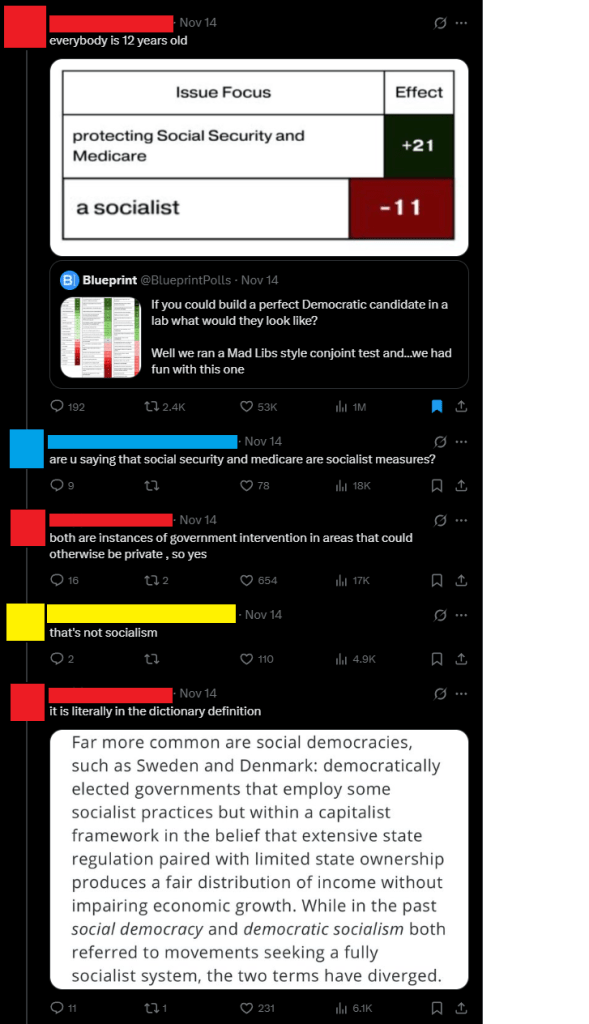
The conversation begins with a user quote tweeting what looks like a poll of democratic voters, asking them questions about what they would prefer in a hypothetical political candidate. In the quote tweet, they post a cropped image of the results which indicate that voting for a person who is “protecting Medicare and social security” is very popular, while voting for someone who is “a socialist” is very unpopular. The user comments “everybody is 12 years old”.
Someone replies “are u saying that social security and medicare are socialist measures?” to which the original poster replies “both are instances of government intervention in areas that could otherwise be private , so yes”
A third user comments “thats not socialism” and the original poster replies “it is literally in the dictionary definition” with a cropped image of a statement which reads: “Far more common are social democracies, such as Sweden and Denmark: democratically elected governments that employ some socialist practices but within a capitalist framework in the belief that extensive state regulation paired with limited state ownership produces a fair distribution of income without impairing economic growth. While in the past social democracy and democratic socialism both referred to movements seeking a fully socialist system, the two terms have diverged.”]
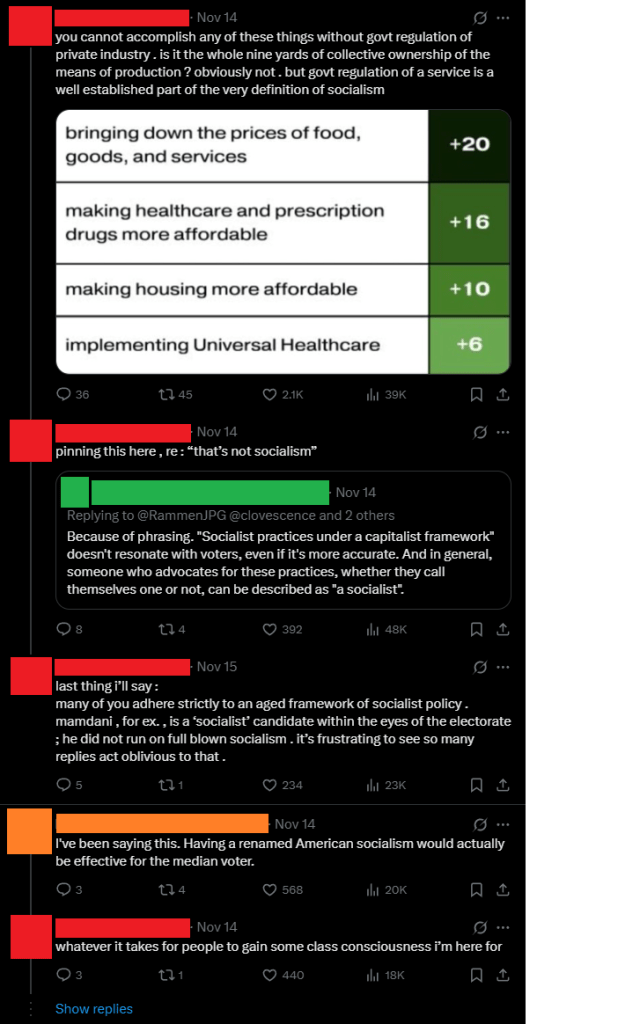
They reply to their own tweet by quote tweeting another user to bring higher visibility to their message which reads “Because of phrasing. “Socialist practices under a capitalist framework” doesn’t resonate with voters, even if it’s more accurate. And in general, someone who advocates for these practices, whether they call themselves one or not, can be described as “a socialist”.”
The original poster self-replies again finishing with “last thing i’ll say : many of you adhere strictly to an aged framework of socialist policy . mamdani , for ex. , is a ‘socialist’ candidate within the eyes of the electorate ; he did not run on full blown socialism . it’s frustrating to see so many replies act oblivious to that .
Another user replies to the first post in the picture saying “I’ve been saying this. Having a renamed American socialism would actually be effective for the median voter.” The original poster agrees, finishing with “whatever it takes for people to gain some class consciousness i’m here for”.]
Here’s a link to the poll result tweet itself if you’re interested. It’s worth noting though that the pollster, Blueprint Research, is funded by Zionist LinkedIn CEO Reid Hoffman who has a history of backing political operations that target Democrats who are critical of Israel. This person made a post about this.
Before I get on to what I really want to talk about I guess it would be a good idea to first get out of the way that the original poster is promoting an idea that is wrong (or at least incomplete). It’s the semantic argument about what qualifies some policy to be called “socialist”. So hopefully I can untangle that enough for the purposes of moving on without thinking back about it too much.
The term socialism (or French socialisme) appears first in the 1830s among French and English thinkers such as Henri de Saint-Simon, Charles Fourier, and Robert Owen, among others. Their ideas for what it meant may have varied but they at least shared a vision that the current society which was organized around competitive individualism should be reorganized around collective or social production. Marx would give socialism its most exact and lasting economic meaning. For Marx, capitalism is a system defined by private ownership of the means of production, wage labor as the dominant economic relation, surplus value expropriation by the bourgeois class, and production for exchange/profit. Socialism, in a strict sense, is defined as a system with social/collective ownership of the means of production, the end or complete transformation of wage labor, surplus value being socially appropriated, and production for use/human need.
Since Marx, there have been countless instances of parties that call themselves socialist which advocate for things other than this particular transformation. In times and places where Marx was very popular, it has been an effective political branding/rhetorical tool for parties to enrich themselves off the mass appeal of Marxism. In times and places where Marx was very unpopular, as in the USA, socialism has been used as a scare word to describe any increase in any governmental involvement to construe it as being radical or subversive. This deliberate misuse of the term is the origin of this meme from Marxist economist Richard Wolff. (maybe Marx-ish economist is a more appropriate description. He’s like THE leading example of a “Marxist” public intellectual who actually commits this conflation himself… while not totally disqualifying by itself, it’s one of many symptoms of what could be a strange and tenuous understanding of Marxism.)
There is also a historical association between welfare programs and socialism because many socialist or labor parties will advocate for welfare-state policies through bourgeois parliaments.
The “dictionary definition” the user pulls is from the Merriam-Webster page for socialism, which is found here. I hope it doesn’t need to be said that a general dictionary isn’t going to give a complete picture of a word as it’s used in a precise theoretical framework. The definitions it offers, which the poster conveniently ignores, are not all that disagreeable. It should also raise some alarm bells that what we’re looking at in image 1 is not the definition of socialism, but is an excerpt from a usage guide to disambiguate socialism, social democracy, and democratic socialism. It offers some background on the divergence of democratic socialism and social democracy, but its point that welfare programs found in social democracies might be considered “socialist policies” is dubious.
Medicare, as an example, is a social-democratic welfare program that reduces cost burden on seniors, but it doesn’t socialize healthcare. It leaves the capitalist profit structure of healthcare intact, so it isn’t a “socialist policy” in any strict economic sense. It’s public payment assistance towards private capital. That this could somehow be considered a “step towards” socialism has been thoroughly contested, and in my view discredited, for over a hundred years. See: Reformism in the Russian Social-Democratic Movement, Critique of the Gotha Programme, Reform or Revolution, or The State and Revolution.
There is no orthodox or mainstream Marxist theoretical basis for using the word socialist in this way, which one might care about if they considered themselves a Marxist. If, as it may be in this case, the person involved in the argument isn’t themselves a socialist, that’s fine, but they have no ground to act indignant and superior towards the general liberal electorate for also misunderstanding the term in much the same way.
In that sense, it’s a perfectly coherent position to be against voting for a socialist but in favor of voting for protection of welfare policies if you’re the type who thinks capitalism ought to be managed and harnessed rather than destroyed and replaced. If it were put more concretely in these terms, it would surely be the vast majority opinion of voters in the Democratic party, as somewhat evidenced by the poll in the first image.
I know my explanation is short here but if you’re still stuck on the point of “socialist policies in capitalist frameworks”, I’m sorry to say that I think you probably won’t get much out of the rest of this blog. I would suggest checking out SocialismForAll on youtube for excellent human-read audiobooks and other material.
You know… despite everything I said, I think being wrong about what constitutes a socialist policy in a capitalist system (if there can even be such a thing in the first place) is fine. Everyone is wrong about shit all the time. Who cares? What I want to talk about is how we can have more effective messaging and outreach as Marxists.
I’m also realizing that this previous section was much longer than I thought it would be. My bad.
I guess there’s really 3 lessons here. Be honest about what socialism is, speak to persuade, and fight for meaning.
First, not all ways of “spreading class consciousness” are equal in worth. Contrast the final message in image 2 “whatever it takes for people to gain some class consciousness i’m here for” with the flimsy position they’re advocating for. In this specific case, it’s clear that the poster just holds an incorrect view. That’s fine. However, we have seen elsewhere, especially in social democrat circles not unrelated to this particular conversation, the idea that we should teach inaccurate but well meaning ideas as a convenient way to try to onboard people to the socialist cause. I say it just isn’t necessary or helpful.
Class consciousness is a necessary step towards socialism, sure, but it isn’t our end goal here. Being dishonest and imprecise about concepts to the so-called backward masses as an attempt to make them more aware of their class position is just building up a conceptual debt that they’ll have to unlearn and relearn correctly later, otherwise they themselves will go about teaching expedient-but-not-quite-complete ideas until it’s muddied to something unrecognizable. It also has a side effect of treating non-communists like kids who aren’t smart enough to understand the real “full blown socialism” concepts, so let’s just make up true-adjacent shit to get them interested in the meantime.
Social programs that assist workers are important. People are justified for wanting them and they are worth fighting for. That doesn’t mean that it’s strategically sound to start telling people “you know, that stuff is actually socialism” to try to superficially win them over or push them left.
It’s like teaching a foreign language, but instead of starting with an earnest and difficult program of phonology from day 1, you teach someone the language using only English phonemes “just to get their foot in the door”, or “to get them interested and feeling like they’re making progress”. So they’re taught terrible and incorrect pronunciation, they’re either not understood by native speakers or they’re infantilized with an “aww, they’re trying” pat on the head. Likewise, labeling Medicare or rent control or labor rights as “socialist” because it’s expedient can delay or prevent people from developing a real understanding of what socialism is.
Second is tone. I’ll repeat that I understand that these people don’t think they’re in some kind of forward-facing position of authority or education on socialism. I’m using this only as an example insofar as it’s also a big problem with the much larger personalities who ARE supposed to be political authorities and educators on the left. And maybe to suggest secondarily that if you’re posting stuff as a socialist, you should feel empowered and take yourself seriously enough to act as a representative of what you really believe. Especially so if you want to publicly represent socialism, which you already do in some sense, whether you think so or not, when you have a conversation about it.
The worst offender is the comment in the first image that reads “that’s not socialism”. The cool, cynical, I’m-smarter-than-you, vague posturing, (ostensibly from someone whose position I might actually agree with most out of everyone in the images) here keeps the poster emotionally safe from criticism, but it’s clearly ineffective political communication. Am I suggesting that this specific user should have gotten as disturbed as I did, to write a fucking blog post about it to explain his position? Maybe not, but hopefully you can agree it’s still worth it to try a little harder and do a little more pedagogical work than what was done here, especially when the person you’re replying to already appears to be on the left and might just need a genuine correction on a definition of a word.
I’m not saying don’t ever sound angry or don’t be mean to people. Bourgeois spaces will never accept Marxists no matter how fresh their haircut is or how straight their teeth are or how good their manners are because Marxism is by definition unpalatable to the ruling class and its defenders. Just don’t fall into smug in-group posturing that alienates or dismisses outsiders if your goal is persuasion (as in: building class consciousness).
Looking at both images, the initial quote “everybody is 12 years old” coming from the same person who claims “whatever it takes for people to gain some class consciousness i’m here for” isn’t just a tone issue but a clear mismatch in function. Being dismissive and belittling to people, while supposedly wanting to win over some imagined “other populace”, somehow not realizing that they’re much the same thing. It should be obvious that very few people outside our cause are going to consider changing their mind because of someone mocking them. It makes them defensive, not interested.
Using a tone like this also increases your reputational risk when inevitably you’re wrong about something, as in this case. It’s hard to walk back from a self-righteous and arrogant attitude when you realize you’re wrong about something, which SHOULD be happening pretty often if you’re taking this stuff seriously. It can lead to arguments where you dig your heels in and feel like you need to defend something which is wrong, or construe it in a vague and confusing way for the sake of preserving your image. That’s liberalism. Socialists need to be willing to show some humility and willingness to be proven wrong, so it would serve us well to at least act like that’s possible.
Third, the pedantry over who the word socialism belongs to. It belongs to socialists. To roll over and concede ground to social democrats, or Merriam-Webster, or the National Socialist German Workers’ Party, or self-described socialist Elon Musk, or whatever other bourgeois element that wants to strip the word of its true meaning, is a total ideological failure. Ideological struggle is partly a struggle over language and meaning. If we’re willing to allow socialism to be defanged to just meaning welfare policies or more government, it’s already a victory for capitalists. They can continue to push socialism to mean whatever they want for their political purposes. Social democrats can call their welfare policies “socialism” to keep people pacified and confused. And socialists have a harder and harder time describing their project.
There’s the comment in image 2 saying that Mamdani, for example, is a “socialist” candidate within the eyes of the electorate, which is true since the electorate has a misguided understanding of the term, but instead of framing this is an ideological problem that we need to struggle against, the poster points this out to confirm their usage of the term in this way as being acceptable because of its popularity. I wonder how, in their mind, the liberal electorate whom they first accuse of “being 12 years old” for their lack of understanding, should now be given credibility as arbiters of the meaning of socialism. It’s really inexcusable in my view.
The same point could be made about an appeal to a Merriam-Webster definition, which, as a side note, is a total red flag suggesting to me that the commenter here probably isn’t a Marxist or is at least very beginner-level. Language is in constant flux. Since ideology is made up of signs, and language realizes signs, language can be understood as the fundamental material and medium of superstructure. See: Marxism and the Philosophy of Language by Valentin Voloshinov. A common dictionary definition might accurately capture its ubiquity within dominant common practice, which in this case is to say, a definition that we should be trying to struggle against in the first place.
It’s a perfectly acceptable position to see this poll and be upset by the contradiction of people wanting welfare policies but not wanting socialism, which is a system that would bring workers benefits beyond what these welfare policies could possibly reach. Most people don’t know what socialism is. So… why confuse people? It connects with my first point here. It’s much better pedagogically to teach the technical language from the very beginninng, the socialist definition, the correct one, and disabuse people from the liberal re-definition whenever it comes up. I’m not talking about making everything as complicated as possible and trying to explain dialectics to strangers online all the time. But at least try to take back some space on the meaning of the very name of your movement, and don’t hodge-podge it with “well he uses the word like this, and she uses it like this, and my enemies actually use the word like this, so it can mean anything anyone wants”. It’s hopefully clear at this point why this isn’t actually helpful.
I’ve spent too long on this already and I don’t know if some kind of conclusion is really necessary. I think socialists can do better than they have been with political messaging and this felt like an admittedly stupid but pretty pure example of some of those issues.

Leave a comment